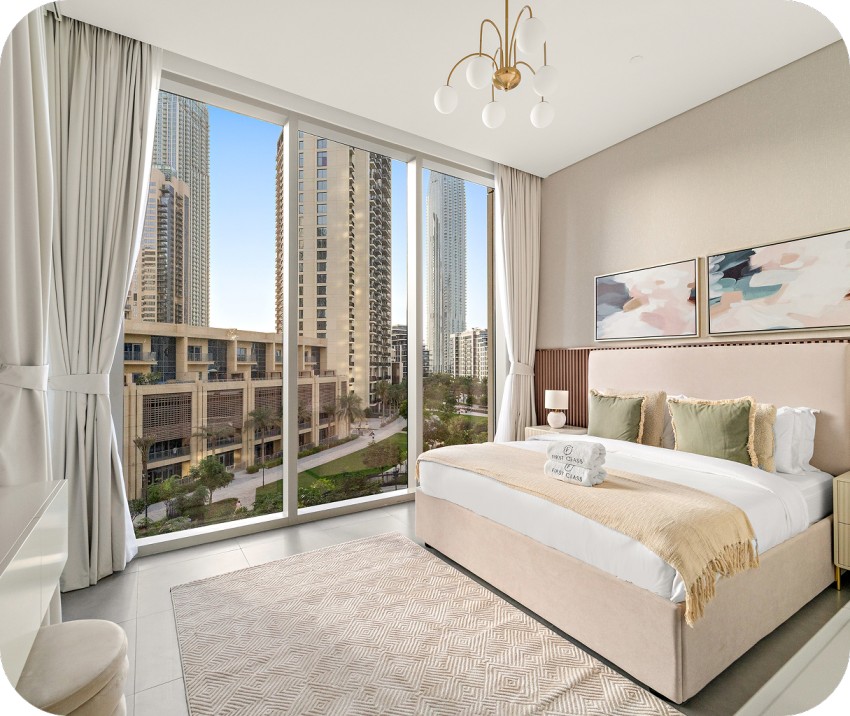
Short-term letting is legal in Dubai provided the property holds a valid permit, and across the First Class Property Management portfolio it returns approximately 27 per cent more than a comparable long-term lease. The trade is operational: that uplift depends on daily pricing, fast guest response, and consistent standards, none of which happen without someone doing the work. Whether that someone is the owner or a management company is the real decision behind the question.
This guide covers the legal requirements, how the revenue actually compares, what the workload involves, and where the line falls between self-managing and bringing in professional support.
The Decision Owners Face
Airbnb has made short-term letting accessible, though accessible does not mean simple. Before listing a Dubai property, four questions need honest answers: whether it is legal, how revenue compares with a long lease, what the workload genuinely is, and at what point professional management earns its fee.
This guide takes each in turn, based on operating data rather than platform marketing.
Legality: Yes, But With Requirements
Short-term letting is legal in Dubai provided the property operates inside the regulatory framework.
DET (Dubai Department of Economy and Tourism, formerly DTCM) requires a valid holiday home permit before listing, guest registration for every stay, tourism fees collected and remitted, and ongoing compliance with operational standards. The framework sits under Decree No. 41 of 2013 and its 2020 implementing bylaw, which also classifies each holiday home as standard or deluxe. In practice that means a permit fee starting at roughly AED 370 a year for a studio or one-bedroom and capped at about AED 1,200, the Tourism Dirham of AED 10 to AED 15 per occupied bedroom per night depending on classification and remitted monthly, and guest passport details filed with the ICP within 24 hours of check-in. The licensing process typically takes one to two business days with the correct documentation.
The requirements are straightforward and they are not optional. Unlicensed properties face fines, removal from platforms, and further consequences, which is why the permit is the first step rather than a later one. The distinction between a platform listing and a licensed property is covered further in the comparison of Airbnb and Dubai holiday homes.
Revenue: The Honest Comparison
The revenue case is strong without being guaranteed.
Short-term rental returns average 27 per cent higher than those of comparable long-term rentals. Occupancy across the First Class portfolio has held above 90 per cent as of July 2026, and the November to March peak supports rate premiums a fixed lease cannot access.
In practical terms, a Downtown one-bed converted from a long-term let has produced around AED 160,000 annually, against roughly AED 80,000 to 100,000 as a long-term lease. For context, citywide hotel occupancy averaged 80.7 per cent in 2025 at an average daily rate of AED 579, which is the demand backdrop a holiday home is pricing into. The gap is real, and it arrives with operational demands attached rather than on its own. Results vary with unit type, location, and season.
The Upside: Why Owners Choose Airbnb
Flexibility is the advantage owners name most often. Dates can be blocked for personal use, pricing adjusted immediately, and strategy changed without breaking a lease.
Peak-season premiums through the winter months, holidays, and major events reach rates a fixed long-term contract cannot. The November to March window carries the Dubai Shopping Festival, which ran from 5 December 2025 to 11 January 2026, school holidays across the main source markets, and the conference and exhibition calendar, while Dubai Summer Surprises supports the softer summer months.
Market responsiveness allows the rate to move with demand, competitor pricing, and local events rather than being set once a year.
Asset control means regular access for inspection, maintenance, and personal stays without tenancy complications.
Those advantages carry a counterweight worth stating plainly. Revenue fluctuates month to month with season, demand, and competition, so there is no fixed income to rely on. Platform dependency is real, since algorithm changes, policy updates, or account issues can affect bookings quickly. Compliance requires continuing attention across licensing, guest registration, tourism fees, and building rules.
The operational reality catches many owners out. Self-managing owners typically spend 10 or more hours a week on guest messaging, check-in coordination, cleaning schedules, maintenance, review management, and pricing. The passive income framing rarely matches what hands-on ownership actually involves.